
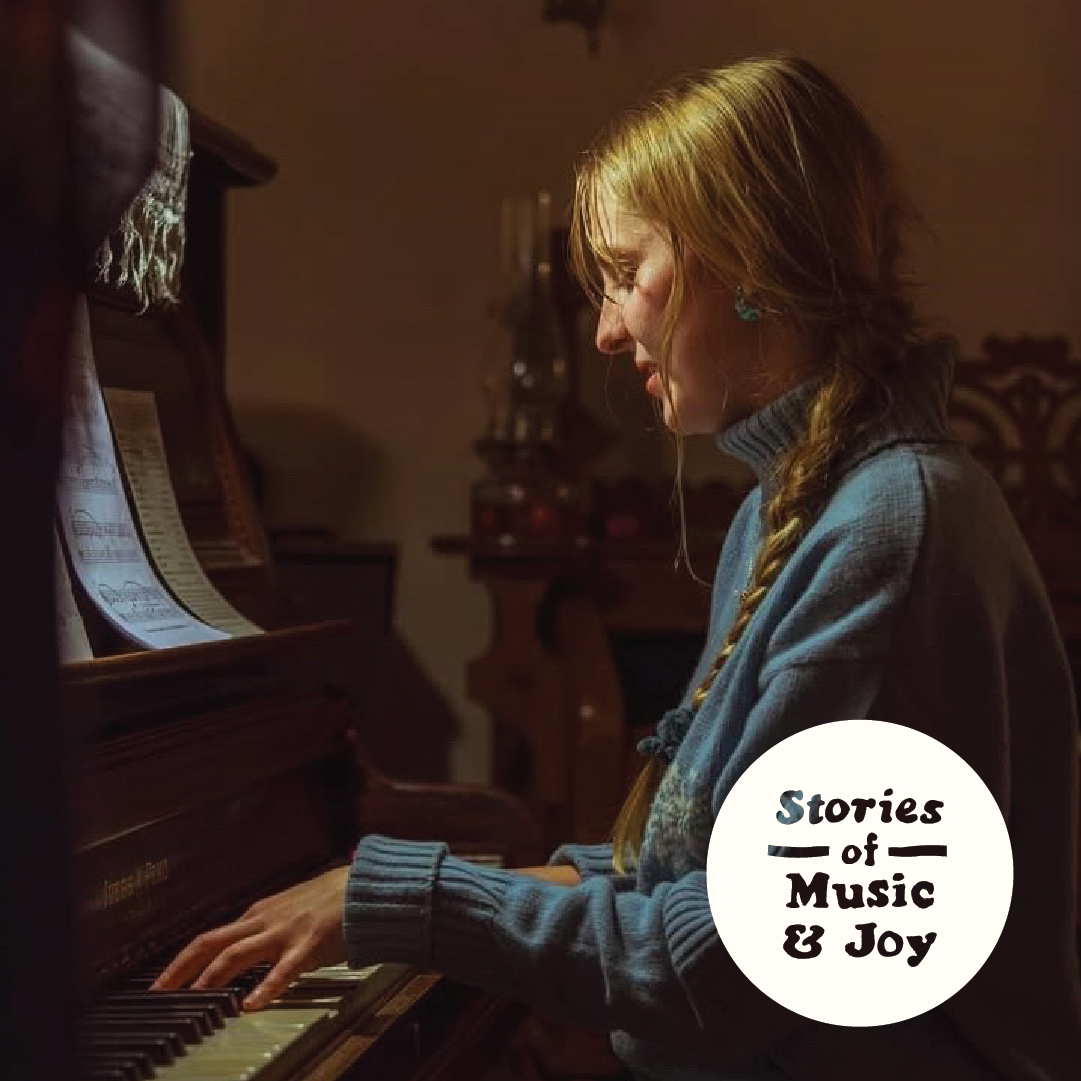
Abby Johnson
Over the past decade, the Middlebury Community Music Center has been a steady community hub for musical learning and expression. We’ve seen a lot of people pass through the front door in that time, from brand new babies to adventurous seniors, and we’ve also had the honor of witnessing the growth and maturation of many of our young adult students. One of those students, Abby Johnson, started taking lessons right around the time MCMC opened and is now a junior in college.
Abby started her musical journey with MCMC when she moved to Vermont at age 10. She grew up in a family that believed music was an important part of a well-rounded education. Everyone played an instrument, but the expectation was never perfection. Abby’s parents hoped to instill a lifelong love of music in their children through exposing them to music at a young age.
This commitment to holistic, student-driven musical growth dovetailed with Sadie Brightman’s practice as a piano instructor and her vision for what MCMC could offer families. When Abby’s family moved to Vermont, Abby gravitated towards Sadie’s approach to teaching. Sadie saw the practice of learning music as offering skills for life, and Abby’s experience as Sadie’s student speaks to the truth of that belief.
Looking back, Abby describes Sadie as “one of those kindred spirits” who has accompanied her “through everything that I’ve experienced in the past decade of my life.” Sadie helped Abby tap into the potential for music to help understand her world and to respond to it creatively. This has shaped Abby’s academic path as well as her personal growth. Even after leaving MCMC and Vermont for college, Abby reflects that “music is still very much a part of everything that I do.”
Abby developed her musical skills at MCMC beyond her lessons with Sadie. She remembers participating in monthly informal salons and performances at elder care centers as formative experiences that contributed to her sense of what music could bring to her community. These programs highlighted for Abby that performing music could be a way of giving back to the community and celebrating personal growth.
These experiences, and working with Sadie, shaped Abby’s relationship to music as a core part of her identity. Rather than being tied to a professional career as a performer, Abby now feels that musical expression “will always be there” for her as a source of “solace” and “lifelong learning.”
This personal growth is reflected in the growth of MCMC over the past ten years. Abby observes how MCMC is “aiming not just to be a place solely for music, but also for this broader level of learning and citizenship.” She sees this growth in the offerings that MCMC provides for infants and new families, as well as its commitment to the “many different ways a person can be educated.” By striving to bring a love of music to the community as broadly defined as possible, MCMC is practicing an inclusive and responsive approach to music education that supports many different entry points and abilities.
To reach her current perspective on the inclusive potential of music, Abby had to overcome the self-criticism and comparisons that accompany many journeys of musical growth. Working with Sadie as a teen helped Abby to practice patience and confidence that comes from commitment rather than talent. Abby observes how MCMC tries to make connections between the lessons learned through practicing music and skills for life beyond performing. This helped her see that “the world needs diverse types of musicians” and that everyone has something unique to offer through their musical expression.
Abby sees how MCMC’s mission of inclusive and diverse musical instruction has had a great impact in the community. By offering “mediums and art forms… that transcend difference,” MCMC creates a “transgenerational” community that is united around a vital human experience - music. For Abby, this fosters a sense of belonging not only among her community in Vermont, but also to a global citizenry of music lovers and makers. In her academic studies abroad and in the fields of musicology and ethnomusicology, she connects MCMC to a global music community and history.
Maintaining this global community can prove challenging. Abby recalls when the global pandemic shut MCMC’s doors and forced a reevaluation of how to keep providing musical instruction and inspiration virtually. Abby remembers this time as a “dynamic” moment for the organization, when it embraced new technology and models to help reach students and community virtually.
Looking towards the future, Abby hopes to see MCMC continue to deepen its community by fostering creativity and connection, two things she says are “at the heart of what it means to be a person playing music.” She sees MCMC as “the longest educational experience I’ve had in life,” a companion in her growth and part of what has shaped who she is today. She encourages new students of any age to “pick up instruments for the first time, to fall in love with them, and to enjoy the beauty of playing.” This beauty is what sustains and shapes a musical life.