
I’m committing to practice every day in the month of May, right alongside our practice-a-thon champions. I’m going for quality over quantity, and the best framework I know - deliberate practice - is too good not to share. I’ve taken students through this method in one-on-one lessons whether they’re aware of it or not, and I’m excited to share it more broadly as something that may resonate across other areas of life, like athletic training, parenting, or any kind of goal-oriented work.
When I first learned about deliberate practice it made so much sense to me. I was overzealous and thought I could dive in on my own and adopt the strategy immediately. It proved to be much harder to internalize than I expected. In fact, the only way I was able to learn this superskill was with a teacher right next to me as coach, referee, companion, and guide all at once. It took months, not minutes, to fully adopt this exponential approach to learning. For me, this took place after graduate school, pretty late in the game of learning my instrument, which is why I’m fired up about sharing it widely, even applying it in micro ways with the youngest learners.
Most of us want practice to lead to results. We want to feel progress, we want to build something we can be proud of. We want our kids to feel good about themselves. We want increased confidence, fuller expression, freedom and ease. We want practice to be reliable. We want practice to be a pathway, not a wall to resist or a puddle to evaporate.
Frustration is a key driver for productive learning, it’s part of how we find the motivation to apply ourselves. But for the frustration to be channeled into something productive, we need good input, and clear steps about how to implement it. Most of us don’t stumble into brilliant genius territory on our own.
Simply stated, deliberate practice is a feedback loop:
Input → goal → execute → feedback → adjust → repeat.
While my experience comes from the piano, this way of working shows up across disciplines, in athletics, language learning, parenting, and any type of work that relies on feedback to improve.
When my teacher asked me to pause (only pause) before launching into another repetition, I felt humbled immediately. My way - looping into another attempt, throwing myself at the passage of music, hurling my way into my best effortful take - was, it turns out, wildly inefficient. I had a really hard time letting go of my way because it had gotten me really far. I was 26 years old at the time and felt pressure to begin my career and to feel competency. Being open to a new way of approaching something so familiar, for me, required some type of intervention. I needed to hear directly from someone who had been through the process themselves and knew how much better it could be.
My gifted and patient teacher sat with me while I rewired my entire way of moving at the piano. She told me she was passing on what she learned from her teacher, showing a selfless and devoted discipline to the craft, something that allowed me to be autonomous and supported at the same time.
Now, I see it as courage and conviction - her willingness to say to me for the 13th time in a row in a lesson, “your thumb is still a little bit low.” She stayed with the cycle of feedback as many times as it took for me to see it and sense it for myself. When I finally connected the part of my brain that could command something different for my thumb, a new level of simplicity unlocked that felt too easy to be true.
Deliberate practice was the framework behind the content that allowed me to transform my playing from what had become halted by injury to something generative and sustainable. I didn’t know this strategy by name at the time, but that didn’t matter. This iterative cycle of learning was only as useful as the information I was receiving, communicated one concept at a time by my teacher at a pace I could actually integrate.
There are a lot of resources on deliberate practice, it’s most commonly known in association with the 10,000 hours rule that was popularized in Malcolm Gladwell’s Outliers, 2008. After its publication, Andres Ericsson, the psychologist whose research Gladwell was referencing, among many others in the field, rushed to the conversation to clarify: it’s not just 10,000 hours. Mastery depends on the quality of focus, input, and feedback, with an emphasis on a coach or teacher being present for the process. This mirrors my experience. Both as a pianist and as a teacher. And this is really good news. If we see 10,000 and think, “forget it, that's too much,” we’re underestimating what’s possible when we apply this type of learning. But if we believe that simply logging hours will get us there, we may feel confused when it doesn’t work.
Who cares about mastery, I just want to have fun. I get that. And there is a strong chance that fun emerges from feeling progress and improvement. If progress is the goal, mastery happens on its own, usually detected in hindsight. And the fun comes from the process.
I played this so much better at home. I believe it. The environment at home allows for a type of learning that doesn't stand up to a more activated setting like a lesson or a performance.
I practiced so much this week and today it’s like I’ve never played it. That makes sense. When we’re operating with repetition that loops on itself we’re not really making progress, we’re reinforcing a short-term memory loop.
I just want to master this and know it for good. Understandable. Even professional musicians build and rebuild, polish and repolish. We all have to work with the limitations of the human mind. If we are willing to apply the feedback we honestly see, and carry that information into our next attempt, our learning becomes more efficient, and our results more durable.
Transitioning from the comfort zone to the growth zone has everything to do with the level of awareness we have about the feedback step. Noticing what didn’t work leads to a new approach, which leads to improvement. We see this kind of iterative learning everywhere - systems improving through feedback - but we can apply it in a very human way. Ironically, slowing down our process is what allows us to detect the truth of what’s going on. And then, only if we use that information to our own advantage can we affect change. It sounds so simple! And again, the concept is very straightforward. It’s the awareness that takes time to cultivate.
We can do that by using our resources, tools, and senses: teachers, video recordings, deep listening. We’re in the state of flow when we get here, operating with a challenge, an objective, and a way to achieve it. Pulling together this concept visually, here’s a way to see how different practice modes lead to different results. Sometimes seeing this process laid out makes it clearer.
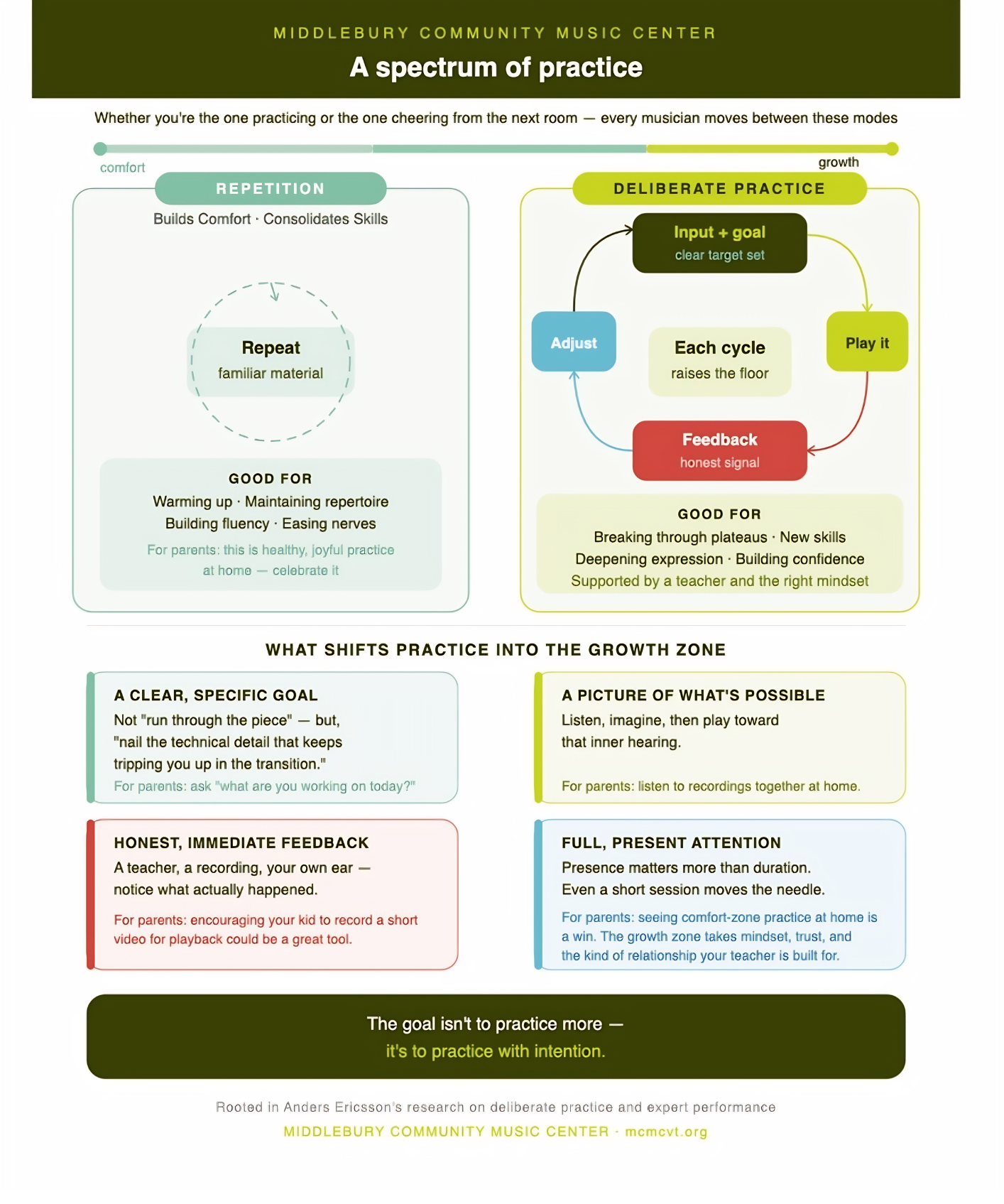
When we understand how learning actually works, practice becomes less mysterious and more empowering. It’s not about doing more. It’s about seeing more clearly what we’re doing.
What I notice as I’m returning to this practice now is how different it feels when it’s not driven by pressure and urgency. The framework is the same, but my relationship to it has changed.