
I came to think about music learning as a cycle when I was in my twenties. I was passionate about playing, passionate about teaching, and learning the balance that would allow me to thrive in both spheres. Too much playing and I needed human interaction and the outlet to share the overflow of insights. Too much teaching and I needed to recharge my batteries and connect to my own creative voice. I thought I had it figured out, a clean roadmap for the roles I was developing and deepening.
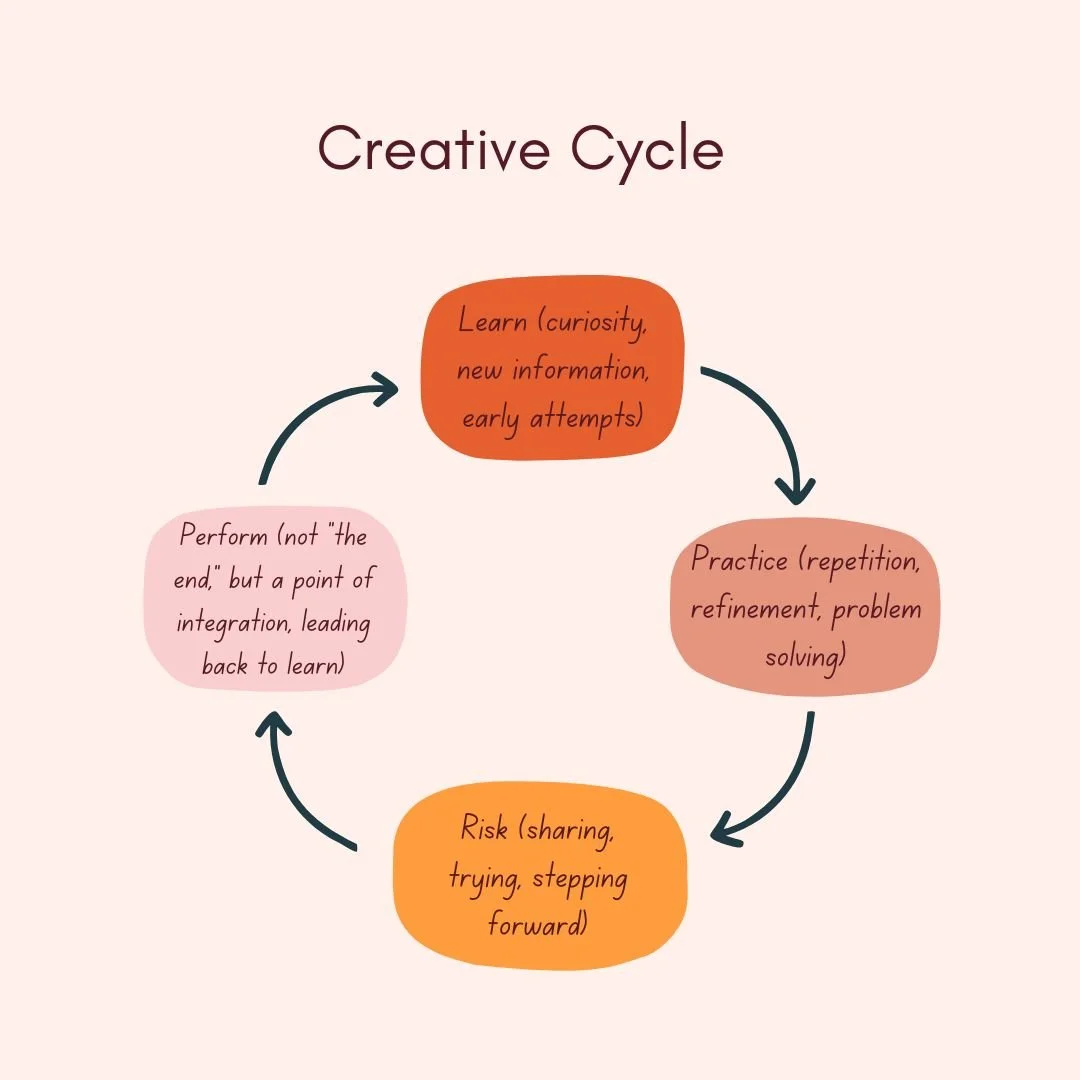
The creative cycle I’ve come to rely on, in music, in teaching, and in life.
I wrestled with it though. I asked myself many times: Is it right to encourage students to perform even if they’re not naturally motivated to do so? Or is that just what I grew up with? Does my practice need to have an “end point” in performance, or is it all just a continuum that doesn’t require a public step? What am I aiming for? Why?
In my studio, which spanned many ages, I noticed it was much easier to cultivate a familiarity with performing when students were very young, before the self-consciousness of adolescence sets in, when the desire to share is still overflowing and unfiltered. I can remember my own daughters at that age, running up to me to show me their latest artistic creations over and over again. I cherish those memories now — their sheer excitement and awe at having crafted something that could be seen and appreciated by someone else. In response to their eagerness, I learned to focus on observational statements and appreciation of effort over praise. “Oh wow, I love that blue, how did you choose it? Look at how detailed that flower petal is! I see you spent a long time making this just how you wanted it to be.”
Does this mean that performing — an extension of the childlike desire to share wonder — could be available as a completion step, not a chopping block of judgement and perfectionism? Could it be solid ground, evidence of an identity shaped around an experience? As in: I am someone who shares my work. I am someone who completes projects and releases them into the world.
I believe so.
But it’s not a guarantee that every performance will be bubble-wrapped and protected from mishaps. The nervousness of high-stakes moments tells a familiar tale, especially when tied to outside opinions and validations.
Who do we become when we see ourselves move past our setbacks? How do we see ourselves when we trip up and then regain our footing? What kind of self-trust forms when we bring ourselves to a challenge lightheartedly, and give ourselves fully to it? In some ways, this is the recipe for fulfillment and satisfaction that so many of us seek.
We had two salons this month, back-to-back. To see one performer after another walk up, bow, play or sing their work, then return to being a listener was to witness human potential. Layer by layer, decision by decision we saw people who shaped themselves into expressive beings with just enough readiness and willingness to present and share. The feeling of completion is so profound that it had Ella finish her Prelude, bow, and abandon her music on the stand as she raced back to her seat with a beaming smile. Done!
It is precisely because of the risk factor that performance is a gift to the rest of us, to the whole of us. Each individual who shares something true sends a message to everyone else, reminding us of what is possible. And even if some listeners in the audience never perform a piece of music in their lives, what else do they have the courage to show up and give in other ways? How else might they be influenced by the bravery they’re witnessing, even from the youngest performers?
Completion. Handing in the assignment. Finishing the project. Reaching the goal.
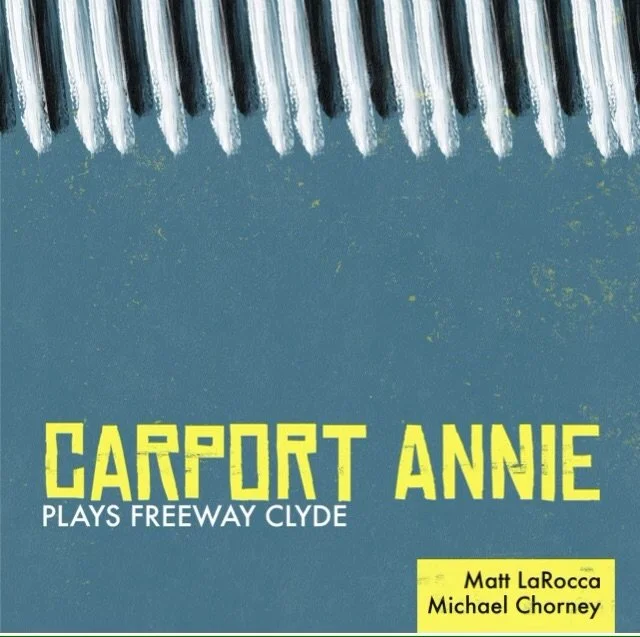
New album released today. So grateful to be a part of it.
I went through a long period of time in which I underplayed the value of completion. I needed to, in order to get back to the joy and creative freedom that fueled me from a young age, before the enterprise became perfectionistic and tight. But now, I’m curious again about this all-important human need, and could not be more excited to celebrate the release of an album that comes out today — Carport Annie Plays Freeway Clyde, music by Matt LaRocca and Michael Chorney — one that I got to contribute to. This is the project I wrote about back in August, detailing the recording session and all that came up about laying down art.
Thinking back on that recording day, the studio fell quiet, the “go ahead” came from Ben in the mixing room. Then the silence. Much like the blank document in front of me before composing this piece for you. A generous invitation containing trust, everyone there fully believed I could create something of value on the spot. All I had to do was believe it too. The flutter of anticipation turned into the groove of experience that set me in motion. It was something imperfect (because it always will be), but honest. Now the process moves to another step, and I carry on with the creation of what’s next.
Completion is not just about finishing something.
It’s a chance to update who we know ourselves to be.
Releasing. Letting go. Celebrating.
That is what’s possible.
Echoing what I’ve learned this year: accessing the quiet inner drive that has pure intentions to create and share; collaborating with other people who bring out our best and challenge our depth; and releasing art into the world without expectation or attachment — simply offering it — is an act of courage and strength.
We can be assisted by all the technologies. We can focus on metrics that fuel the machinery of everyday life. We can check off the to-do list and sharpen our productivity. But nothing will match the feeling of going inside to pull out something that feels real, that has meaning, and that must be expressed and shared.
That’s the human spirit that we’re celebrating.
Let’s gather up all the moments 2025 held and breathe them into the version of who we are now that we’ve come through the learn-practice-risk-share cycle. And may we greet 2026 with open hearts and ears to ask each other for more of these precious moments, and to remember that we all have the potential we admire in others.